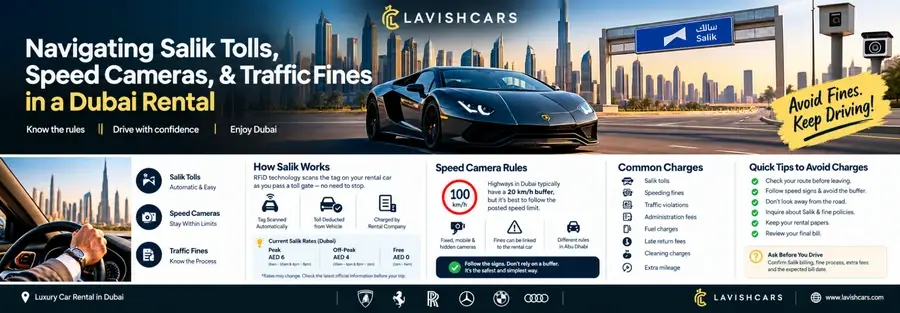
You can get a charge to your rental car as you drive through the Salik gate. A speed camera can catch you even if you don’t realize you are being caught. This can cause lots of questions to mind if you are driving a rental car in Dubai for the first time. Who pays Salik charges? What do you do if you get caught speeding in a camera? Does a traffic ticket get to you after you return the car?
This guide covers Salik’s tolls, speed cameras and traffic fines during Dubai car rental. You’ll also discover what to inspect with the rental company before heading off and how can you avoid mistakes.
How do Salik toll tags work automatically in rental cars?
Radio Frequency Identification (RFID) technology installed on the windscreen of rental cars is used to scan a Salik tag as you pass a toll gate without having to stop.
Salik is the electronic toll system of Dubai. It employs a small tag attached to the car windscreen. The system reads the tag when the car passes a Salik gate, and saves the trip. According to the official website of Dubai tolls, all tolls are deducted automatically from the vehicle as it passes through a toll gate.
You can learn more about toll collection and applicable toll arrangements on the official Salik website.
This also applies to car rental. The car already belongs to the rental company. The Salik system is typically mounted on that vehicle. During your rental, the company you rent from can then see the tolls associated with the car. If you rented a car, you will not normally be required to purchase another Salik tag. There also is no need to stop if you encounter a Salik gate.
Let’s say you rent a Lamborghini for three days. You are driving from Dubai Marina to Downtown Dubai and drive through Salik gate. The crossing is recorded on the gate. You keep driving. The rental company can claim or receive that Toll Charge later.
The exact manner of the charge is depends on the rental company. A few companies may tack on Salik charges at the end of your bill. There could be a different billing process somewhere else. There also may be a service or administration fee. This is why it’s important to be able to read the rental agreement before driving off.
Look for information about:
- Salik charges
- Toll billing
- Service fees
- Traffic fines
- Administration fees
- Final billing
Salik has also created systems that could help vehicle fleet and car rental operators in billing for their users. There’s one easy trick to avoid confusion. Be aware of where you’re driving. If you are driving on major roads regularly, you may even have multiple toll gates cross your rental.
You can check out the Dubai luxury car fleet before you renting. After learning how the toll system works, it doesn’t matter what kind of car you rent, and the basic idea remains the same.
How much does Salik cost for a rental car?
Your charge depends on the time you pass through a toll gate of Salik. The Dubai Salik has been launched with a variable Salik pricing system from January 2025. The published structure of the weekdays currently suggests the ticket will be AED 6 at peak time and AED 4 at off-peak time. The toll is free from 1:00 am to 6:00 am. It costs AED 4 on Sundays except during the free early morning period. The peak hour of Ramadan can be different.
Currently published timings are:
- Peak: 6:00 am to 10:00 am and 4:00 pm to 8:00 pm on weekdays
- Off peak: 10:00 am to 4:00 pm and 8:00 pm to 1:00 am
- Past midnight: 1:00 am to 6:00 am
- Out of free early morning hours; Sunday: AED 4.
These rules and rates can change. Verify the current official information before your travel. If you are renting a car for a few days, and you go through two toll gates every day, you could find that you have multiple Salik charges by the end of the rental.
However, this does not mean that you are fined. It is just the fee for the toll road, there is no surcharge or extra charge involved.
What are the RTA speed camera grace limits on Dubai highways?
Highways in Dubai typically impose an unofficial allowance limit or buffer of 20 km/h over the authorised speed limit in response to speed cameras (radars) giving a fine.
But this should not be considered as an additional speed allowance you are entitled to use. The road sign is the best way to signal the buffer to current and past drivers, though older and current non government sources describe it. If a road sign states 100km/h, do not aim for 120km/h to reach that speed.
Limit driving to 100 km/hr or less as indicated. Why? Speed limits are subject to change, depending on the road. Electronic signs may also display a minimum limit. There may be varying controls for road conditions, work areas, school zones and other areas. A speed buffer does not mean you will never get a ticket. It can also be a problem if visitors drive outside of Dubai. The rules around speed enforcement, for instance, differ in Abu Dhabi and do not include the 20 km/h buffer method.
When you are renting a car for a Dubai trip, there is one really simple rule to follow:
Follow the number shown on the road sign. Do not plan your driving around a camera buffer. That way it is simpler and requires less stress.
How do Dubai speed cameras catch rental cars?
The Dubai city has installed speed cameras to detect vehicles breaking the speed rule. There are cameras which are secured to the road. Other camera systems are available for installation in various locations. In the past Dubai has also been employing less visible and mobile camera systems. Don’t think you are safe just because you didnt see a camera anywhere. The vehicle can be recorded by a camera. The car’s plate can then be linked to their traffic record. If you commit a traffic violation in a rental car, the infraction can be assigned to the rental car. Dubai Police traffic services include the ability to search for fines by vehicle plate number, driving license number, or traffic code. Therefore, the best way to stay safe is to avoid learning where all of the cameras are. It is to drive on the road at the maximum speed permitted.
What happens if you get a speeding fine in a rental car?
The process is easy to understand.
- The violation is recorded
The vehicle is captured by a speed camera if a speeding offense is detected.
- The vehicle is linked to the rental company
The car is registered to the rental company. The company can therefore become involved in the fine process.
- The renter may be identified
The rental company holds rental agreement and details of the driver. It could leverage this information to find out who was in the car at the time of the infraction.
- The fine may be passed to the renter
Traffic fine could be charged to the renter by the rental company. There will be additional company rates. Some rental companies could charge an administration or processing fee. That will depend on the terms of the rental contract.
The exact process can differ between companies. So, even if you rent a car, you are not protected from traffic fines. Speeding is also just one form of traffic offence. Traffic violations include speeding, mobile phone use during driving, red-light running, parking in the wrong spot, and others, according to the Dubai official website.
Billed charges with Zero Markup Guarantees
If a rental company provides billed rates without adding any profit, find out what is included. The amount of the billings should be viewed independently from traffic fines in LavishCars. When you have a zero markup policy, that doesn’t mean you don’t have to pay traffic fines at any time. It also will not cancel a Salik toll that is placed during your car rental. The key difference is simple. A charge for the use of a tolled road. Traffic fine: A fine imposed for violation of a traffic rule.
If the billed charge is not being billed at you with no markup, the number should be explained based on the applicable rental terms if the LavishCars confirms this. Before booking and hiring the vehicle, please consult the specific conditions for the vehicle you can find in the booking and rental conditions. This is a good reason why it’s better to look at your rental bill rather than just your total bill.
How to avoid Salik charges and traffic fines during your rental
Avoid Salik charges and traffic fines during your rental by planning free routes, following traffic orders and understanding your rental agreement.
You don’t have to worry about all the cameras or toll gates on your vacation. There are some simple things to do that can help.
Check your route before leaving.
Always know where you are going. This can be useful to know whether your travel route might be exposed to toll roads.
Pay attention to speed signs.
Don’t memorize the limit. Observe the signs on the road while driving.
Avoid speed buffer.
If someone says they can drive faster with a camera, don’t do this.
Do not look away from the road.
The roads in Dubai can be very busy very fast.
Inquire about Salik before driving the vehicle.
Find out how the company records and bills toll trips.
Ask about traffic fines.
Know if the company charges an administration fee when it processes a fine.
Retain the rental papers.
Keep proof of your agreement and payment until your rental is paid in full.
Verify the last statement.
Review all tolls, fines and fees post-rental.
If you are looking for a vehicle, you can look at the Dubai luxury car fleet and select the best car for your trip. A Lamborghini Urus rental Dubai may be perfect for the bigger luxury SUVs for those who seek additional space without compromising on the sporty ride.
What should you ask the rental company before driving away?
Before you leave, ask the rental company about the fuel policy, emergency contact information, and any past damage that isn’t mentioned on your paperwork.
If you’re a first time renter, there are some basic questions that you should ask before you leave the rental office.
- How is Salik billed?
- Do you have an additional service charge for Salik?
- How is traffic fines paid?
- Is there any other type of fee for administration?
- When will I receive my bill?
- What does this mean if a fine shows up upon my return of the car?
- May I have breakdown of toll/fine charges?
None of these questions is too awkward to ask. The vehicle is being rented and you are paying a fee for that. It’s important to be aware of any additional fees that may be incurred.
This can also help if picking up a car in a busy area. If you are planning to stay near the coast, there are Dubai Marina car rental options that you can check out before your pick up.
Rent Salik-Equipped Luxury Fleets in Dubai
Knowing what to expect makes driving a luxury rental in Dubai easy. Salik will automatically record the toll charges as your rental car goes through toll gates. The roads are monitored by traffic cameras. Financial penalties for motorists for traffic infractions can be attached to the rental vehicle and be levied against the renter as part of the rental contract. You do not need to avoid driving around Dubai.
There are just a few rules to know before you begin. Review your rental agreement. Inquire about what Salik is charged for. Follow the posted speed limits. Watch road signs. Maintain rental reports until all rents have been paid.
Ready to choose your car?
Explore LavishCars.com | Luxury Cars Rental Marketplace | Dubai Fleet and find a luxury rental for your next Dubai trip.
Frequently Asked Questions (FAQs)
he majority of rental cars on Dubai's roads are equipped with the Salik system, which allows them to collect tolls. Ask the rental company how the specific vehicle is set up and how the charges will be billed.
No. Salik is an Automated Toll Collection (ATC) system. Typically it is a barrier through which one passes without stopping or paying money at the barrier. The trip is recorded in the toll set up of the vehicle.
No. Salik is a road toll. Traffic fines are fines issued for violating traffic laws.
The renter is normally responsible for tolls created during the rental. Payment process will vary according to the rental company's agreement.
Yes. Dubai traffic rules must be adhered to by hiring cars for rent in Dubai. A camera can capture a violation, and the rental business can send this to the renter at a later time.
Yes. A traffic record can take some time to get to the rental company. Keep rental documents and payment records until all is paid.